Showing posts with label Plot - Romance. Show all posts

Sunday, April 25, 2010

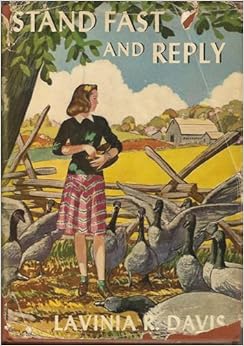
Stand Fast And Reply (1943)


Lavinia R. Davis,
1943, The Junior Literary Guild and Doubleday, Doran and Company

The summer visiting Aunt Helen up at Rye had been a flop. Aunt Helen hadn't known any of the younger crowd, and though Bitsy had tried to make friends she had stayed an outsider. She had comforted herself with the thought that at Sea Cliff she was one of the gang, but now, after two days, she wasn't at all sure. Bitsy felt cold and apprehensive as it occured to her that maybe she was the one who had changed. She had been something of a leader in the old rough-and-tumble, kid days, but maybe from now on she would always be on the outside.


When 17-year old Elizabeth "Bitsy" Close overhears the smoothest, most desirable boys in their upscale shore resort dismiss her as a kid, she's horrified at the idea that she might be socially doomed when she returns to her private Manhattan school in the fall. She's actually relieved when her parents break the news that a) bad investments have drained their finances and b) this, plus her father's orders overseas, means that her, her mother and her little brother Stanton will not return to their New York City apartment, but go live with relatives on a farm in Ohio. It may be strange and remote, but at least she won't endure the snubs and humiliation of being a social failure.

After a series of inevitable misunderstanding and awkward moments as the New York girl raised among catty socialites mingles with plain-spoken and taciturn farmers, Bitsy proves herself a hard worker. And her novelty makes her an instant hit at her new school. In short, the move does work out nicely for her social status. In the contrary way of things, however, that means less than it did in New York. With chores and farm work to do, the students scatter each afternoon, and Bitsy's no exception. Her closest friend is her cousin Tim, whose dedication to farming is in contrast to his older brother's; Bruce dreams of machinery and longs to be an airman, a desire inflamed by the nearby air base. Tim's a pure farmer; impressed by Bitsy's city style, he's more impressed by her willingness to help out on the farm.

"Wait until you meet my cousin Bitsy," he said proudly. "She's some looker and she works like a man."

Then her old life rears its head in the form of Byrd Gaylord (and here I pause in appreciation of such a name), the smoothest and most desirable of those older boys who'd dismissed her months earlier as a kid. Now, though, Byrd is in the Air Force and, lonely for his old world, latches onto her as a familiar face. Flattered and newly confident by her success in Ohio, Bitsy returns his interest. But is Byrd really what she wants from life?

A well-written story with an engaging heroine and atmospheric surroundings. Bitsy's a tad too adaptable; she tends to quickly grasp what she's doing wrong and correct it without trouble, and her social success is a bit overdone, if satisfying. Unusual book, in that she doesn't struggle much with the typical teen stuff, but cuts to the chase with the big issues - who to marry, what life to live, the survival of the farm, etc. Maybe because this is a war book, Bitsy's focused much more on adult issues than on teen ones.

A few things rankle or stand out. Bruce's casual dismissal of the Polish immigrant farm hand Steve as a dumb Pole, and the confusion whether he's mildly retarded or just a foreigner with limited English and emotional problems from WWI. The creepy trick Steve plays with a dead dog. The use of the word 'terrific' as a synonym for 'terrible.' The cool evaluation of a neighbor boy upon meeting Bitsy for the first time, as he sums her up as a nice piece. Tim's bluntness, which is meant to be natural but which seems to afflict him mostly around Bitsy; he's plenty smooth and courteous around a major from the nearby air base, for example. And finally, one character uses the phrase 'squaw winter,' apparently a regional term for the first freeze of winter, and which I've never heard before; Indian summer, yes, squaw winter, no.
About the author
(1901-1961) Lavinia Riker Davis also wrote as "Wendell Farmer."
Other books

Young Adult
Come Be My Love
Hearts In Trim
A Sea Between

Children's
Buttonwood Island
Plow Penny Mystery
Pony Jungle
Hobby Horse Hill
Melody, Mutton Bone and Sam
Sandy's Spurs
Janey's Fortune
The Secret of Donkey Island
Donkey Detective
We All Go Away
Americans Every One
Adventures In Steel (NF)
Island City: Adventures in old New York
It Happened On A Holiday (SS)
Round Robin
Spniney and Spike and the B-29

Easy
Roger and the Fox
Danny's Luck
The Wild Birthday Cake
Summer Is Fun

Adult
Evidence Unseen
Threat Of Dragons
Barren Heritage

Short Stories (children)
"Champion Fire ’n Feather" in the anthology Great Stories About Dogs

Links
Jane Cowl dahlias


Tuesday, April 20, 2010

Frances By Starlight (1958)

Frances By Starlight
Winifred E. Wise, il. Evelyn Copelman (cover)
1958, Macrae Smith Company

Spring was late this year, but Franny Cochrane was early. Burrowing in the back of her big closet, she felt frustrated. All the clothes she didn't want came out of nowhere to fall down on her head; they were all the tiresome winter dresses and tops and skirts that she had been wearing for a thousand days and years and months - or so it seemed. But somewhere amidst the ghostly clatter of empty hangers there ought to be a dress of daffodil-yellow cotton that seemed to her to be the essence of spring! She finally found it - but laid away in a box and sadly in need of pressing.

18-year-old fashion design student Frances Cochrane is discontented. Boyfriend Hank treats her more like a pal than a special, fragile flower, her two brothers aggravate her, and she's thoroughly conquered her Chicago environs. Now she dreams of getting out of the Midwest for the summer. The chance arrives with her wealthy aunt Fran, who readily agrees to take the teen back to her California home for a whirl of social activity. But Fran has her eye on a different goal - Hollywood, and a chance to use her design training in the costume world. She soon discovers the barriers between her and that dream. Brooding wannabe actor Michael Ybarra gives her an inside track to a job as a messenger girl on the studio lot of Triumph Productions. And eventually Frances gets - and with Mike's help, takes - her chance.

"What's wrong with being a butcher?" Franny asked with asperity.
"Everything - if your ancestors were Spanish landlords like mine happen to have been."

Along the way, she's fallen in love with Mike. The class-conscious, sulky, handsome young actor is forever on the make, a quality that puzzles Frances, who balks at the amount of lying and toadying he does to further his career prospects. Frankly, it's never really explained why she's in love, except that she's temporarily in a land where lemons grow on trees and working in a place where you see movie stars, and she's slightly addled by it all. And then, as another wannabe-Mike-girlfriend describes him:

"There's something about him. Makes you think that if he had just the right girl, he'd be different. If he'd only let you be the girl, you know."

That's a highly dangerous quality in a boy.

A generally fun, well-written book, with a gratifying emphasis on the girl's ambition over romance, and her rueful realization that great ambitions come with a social price.


Wonderful
* The stars Frances spots are Danny Kaye, Mel Ferrer and Jeanne Crain
*When Mike picks her up for a day at the beach, she innocently asks why he's lashed a toboggan to the roof of his car - it's a surfboard.
* the bit about horse operas, and the studio lots filled with NYC streets


About the Author
1906-1993
Winifred Esther Wise was born in Fond du Lac, Wisconsin, and worked as a reporter, a writer on Comptom's Encylopedia and as an ad exec at Marshall Field & Company. She married Stuart Palmer (1905-1968), a writer of mysteries who did the Miss Hildegarde Withers series. They lived on a ranch in the San Fernando Valley, and had three children. In the Wisconsin Academy Review excerpts from her unpublished autobiography, Wise writes of her experiences in WWII Chicago and living in a remote house on the dunes in Indiana with her first daughter, Jennifer.

Links
Wisconsin Academy Review article - The Life and Times of Winifred E. Wise (I)
Wisconsin Academy Review article - The Life and Times of Winifred E. Wise (II)
Wisconsin Academy Review article - The Life and Times of Winifred E. Wise (III)
Wikipedia on Compton's Encyclopedia


Books -fiction
Frances A La Mode
Frances By Starlight
"Minnow" Vail
Tammy: Adventure in Squaw Valley
The Wishing Year

Books - nonfiction
Thomas Alva Edison: The Youth and His Times
Young Edison
Jane Addams of Hull-House
Swift Walker: A True Story of the American Fur Trade
Thomas Alva Edison. (Real People series)
Rebel in Petticoats. The Life of Elizabeth Cody Stanton
Harriet Beecher Stowe: Woman With a Cause
Fanny Kemble: Actress, Author, Abolitionist
Fray Junipero Serra and the California Conquest
Benjamin Franklin

Easy
The Revolt of the Darumas

Not sure
Away With the Circus
Lincoln's Secret Weapon
Wildwood
Chipula: A Saga of Old Hungary. Privately printed for Theresa Renner, 1969.
Forget-Me-Nots and Pigweed: The Life and Times of Winifred F. Wise. Unpublished, 1993.

Wednesday, February 10, 2010

Blueberry Summer (1956)


Blueberry Summer
Elisabeth Ogilvie
1956, Whittlesey House
(edition shown: Tab Books, Scholastic)


She was seeing herself, or rather a version of herself that no one had ever seen, wearing the charcoal Bermuda shorts and the pink Italian-style shirt; the short yellow shorts and the strapless sun bra; the white-satin swimming suit against which her tan would have a warm rich glow.

16-year-old Cassandra Phillips, sitting on her bed in her parents' Maine farmhouse and dreaming over a catalog of new clothes, has no way of knowing her promised summer working as a waitress on Makinic is dissolving. Her glamorous older sister has broken a leg, triggering a chain of events that traps Cass at home to milk the cow, oversee the blueberry fields and wrangle her rambunctious 8-year-old brother Peter.

But being home all summer has advantages. A handsome older boy, Adam, arrives, and then a lazy artist who promises to fulfill Cass's dreams of a romance. There are problems too - the shiftless but friendly Blackwell clan become suspects in a string of lobster-trap robberies and a deer-jacking, and tourists wander into the blueberry fields.

Overall, an interesting and well-written book with an appealing heroine. Her silliness about her artist neighbor is painful but realistic, and her love-hate relationship with her little brother rings true. Even the slightly too-good-to-be-true love interest is realistic and likable.

Other books (for teens)

The Fabulous Year
Whistle for a Wind
How Wide the Heart
The Young Islanders
Becky's Islands
Turn Around Twice
Ceiling of Amber
Masquerade at Sea House
The Pigeon Pair
Come Aboard and Bring Your Dory!
Beautiful Girl
Too Young To Know
My Summer Love


About the author

1917-2006
A prolific writer, she was the author of over forty books, many set on the coast of Maine.

Links
Obituary in the Boston Globe
Obituary in the New York Times

Saturday, January 30, 2010

The Popular Crowd (1961)


Anne Emery
1961, The Westminster Press

It's sophmore year and Sue Morgan has one goal: become one of the popular crowd at her high school. A successful summer away has given her confidence, and the local stature of her older brother Gary, a football star at college, has given her a start. She nabs her school's football star, Pete Carroll, and every popular door opens from there. And so what if she no longer has time for old friends or studying? Being popular takes work, and so does keeping Pete happy. Over a long school year, Sue discovers just how much work it takes to stay in the popular crowd.

Pete finds it inconvenient to go steady with Sue when he'd like to date everything that shows interest, and leverages that into constant demands for more necking and more sexual activity.

In his enthusiasm he kissed her long and passionately, prepared to go on from where she had stopped him before. It was a constant battle, Sue thought irritably, pushing him off and finally hitting him hard enough to make him listen.


She quickly becomes sick of fending him off, though the author makes it clear she does enjoy some of the sex play.

Sue felt the excitement building up. Even without liking him too much, she could be easily aroused, and she half dreaded, half anticipated the approaching love-making.

Sadly timeless is Sue's weary, cold-blooded realization halfway through the year that she can live with that, with sexual activity she doesn't enjoy much with a boy she doesn't love. Her unease at his ethical shallowness goes much deeper. His personality can be summed up by his comment:

Say, I like your brother, Sue. He's a real contact.

Pete is an operator. It's interesting that in a book written in what is now considered a sexually repressive time, Emery gives his calculating opportunism as much moral weight as his pressuring Sue for sex.

Sue's siblings are her greatest asset; older brother Gary's popularity is her key into the crowd, while her more thoughtful brother Sandy gives her a different perspective on popularity and Pete, and her little sister Marilyn's progress into the same crowd gives Sue a vague sense of not wanting her baby sister in the same things she's gotten into. Her parents are hopeless; a cipher dad and a mother who accepts everyone at face value.

Sue's progress from adoring the football hero to coldly assessing her complete lack of affection for him - and her dying interest in any boy - is chilling.

Author Bio
1907-1987
Anne Eleanor McGuigan was the eldest of five children with a father who was a professor. She graduated from Northwestern University in 1928, spent a year traveling with her family, and then began teaching. She married John Emery in 1933, and had five children. The Illinois town of Evanston appears to be the model for Sherwood; she lived in Evanston most of her life.


Other Books (with my previous reviews linked)

The Burnabys
Senior Year - about Sally
Going Steady - about Sally
High Note, Low Note
Campus Melody
Sorority Girl

Dinny Gordon Series:
Dinny Gordon, Freshman
Dinny Gordon, Sophomore
Dinny Gordon, Junior
Dinny Gordon, Senior

Jane Ellison 4-H
County Fair
Hickory Hill
Sweet Sixteen

Pat Marlowe
First Love True Love
First Orchid for Pat
First Love Farewell

Sue Morgan
The Popular Crowd
The Losing Game

Other Books
Scarlet Royal
Vagabond Summer
That Archer Girl
Married on Wednesday
A Dream to Touch
Tradition
Bright Horizons
Mountain Laurel
Jennie Lee, Patriot
American Friend: Herbert Hoover
Mystery of the Opal Ring
Danger in a Smiling Mask
Carey's Fortune
The Sky Is Falling
Free Not to Love
Stepfamily

Spy books
A Spy in Old Philadelphia
A Spy in Old Detroit
A Spy in Old New Orleans
A Spy in Old West Point

Links
Image Cascade - the Sue Morgan books

Tuesday, December 29, 2009

Going Steady (1950)

Going Steady
Anne Emery
1950

Sally Burnaby's a 17-year-old whose long summer after high school graduation is a mixture of the delights of having a steady boyfriend and the frustrations of being almost but not quite an adult. Despite the dated nature of the material - did that world ever exist, even in 1950? - and the way the author's evasion of certain topics makes her heroine look a bit dim at times, it's a more honest examination of being female, young and (inescapably) naive than most of the current crop of cutting-edge problem novels.

At the book's start, Sally appears to be just a cute teenager. She's completely absorbed with her boyfriend, Scotty, and restless with being more than a child and less than an adult in a busy family. She's set to attend college in the fall, but she grows increasingly aggravated by her own sense of inadequacy as the summer progresses. Scotty, for all his good qualities, possesses that typically male trait of overweening confidence, and Sally grows anxious to gain his approval. She's indifferent to tennis and diving, but struggles to get better at both because he excels at them and simply expects her to want to improve. She can drive a modern reader insane with this, and with the way she hesitates to even share a difference of opinion. But has this really changed? Don't many girls still fall into line with male opinion, become caught up in trying to 'live up' to male expectations even in subjects and fields that don't interest them? A more frustrating anarchronism is the way Sally's parents agonize over how the relationship will impact Scotty. I do not like this behavior, having had a similar conversation once with a brother who implored me not to 'hurt' a boyfriend. Boy-boy loyalty apparently trumps blood ties.

Apart from her romance, Sally's other major concern in this summer is her position in her family, and how that's changing. Aware suddenly that all her friends have summer jobs, she realizes belatedly that maybe she's expected to work too. When she does get a job, she hates it, does it poorly, and realizes belatedly that she was wrong to approach it with such slipshod indifference. And she spends her first paycheck on a frivolous item instead of contributing to the family finances or buying a needed coat. These are somewhat old-fashioned ideas; I wonder how many middle-class kids really feel pressured to help support themselves at 17 today - but one thing is timeless. Sally feels that all her bad decisions are irrevocable, that she just keeps digging herself in deeper without remedy. She's haunted by a steadily worsening sense of having repeatedly failed to understand or figure out the right thing, whether it be with Scotty or her job or her family. What she thought would be a beautiful summer with her steady boyfriend turns into a long, hard season of growing up, and by the end of it, both she and Scotty are panicking, so frustrated by their family woes and personal confusion that they agree to take a leap into a different life. But is marriage at 17 really what Sally wants?

The terms of 'going steady' are utterly outdated and adorable and largely alien to anyone born after 1940. Sally's observations of her coworker Carol, a 26-year-old who's desperate to find a husband and escape drudge work, are painfully realistic, even in the 21st century. Go to any library and choose 3 books with pastel covers, and they'll all be chick lit with Carol as the heroine. The only difference will be the modern format's fantasist insistence that most Carols are actually successful career women with expensive shoe collections. Sally's friend Millie, on the other hand, probably doesn't exist anymore. Sudden pregnancy usually derails modern youth engagements, it doesn't result in shotgun
marriages.


Author Bio

1907-1987
Anne Eleanor McGuigan was the eldest of five children with a father who was a professor. She graduated from Northwestern University in 1928, spent a year travelling with her family, and then began teaching. She married John Emery in 1933, and had five children. The Illinois town of Evanston appears to be the model for Sherwood; she lived in Evanston most of her life.

Other Books
About the Burnabys
Senior Year - about Sally
Going Steady - about Sally
High Note, Low Note
Campus Melody

Dinny Gordon Series:
Dinny Gordon, Freshman
Dinny Gordon, Sophomore
Dinny Gordon, Junior
Dinny Gordon, Senior

Jane Ellison 4-H
County Fair
Hickory Hill
Sweet Sixteen

Pat Marlowe
First Love True Love
First Orchid for Pat
First Love Farewell

Sue Morgan
The Popular Crowd
The Losing Game

Other Books
Scarlet Royal
Vagabond Summer
That Archer Girl
Married on Wednesday
A Dream to Touch
Tradition
Bright Horizons
Mountain Laurel
Jennie Lee, Patriot
American Friend: Herbert Hoover
Mystery of the Opal Ring
Danger in a Smiling Mask
Carey's Fortune
The Sky Is Falling
Free Not to Love
Stepfamily

Spy books
A Spy in Old Philadelphia
A Spy in Old Detroit
A Spy in Old New Orleans
A Spy in Old West Point


Links
Image Cascade Publishing

Wednesday, July 22, 2009

Two's Company (1951)

Two's Company

Betty Cavanna, il. Edward J. Smith

1951, The Westminster Press


Along the flat, straight road to Williamsburg the slender branches of Scotch broom were strung with flowers, but Claire Farrell, driving her new convertible slightly faster than the speed limit, saw only a blur of yellow.


18-year-old New Yorker Claire Farrell chases her winter boyfriend, actor Whit Bowden, south for the summer. He's appearing in a summer theatre near Williamsburg, and Claire has hastily invited herself to stay with her grandparents, who live in the town. Also living in their old Virginia home is summer boarder Philip Young, an architect working on the restoration, who Claire understandably dislikes from the moment he virtually carjacks her on the road to town. Over the course of the summer, Claire learns to slow down and appreciate more than her beautiful boyfriend.


Claire, a headstrong and somewhat bullying personality, isn't exactly appealing, but her struggles make her sympathetic. Her patrician old grandfather's opinion puts the reader firmly on her side.


"She's selfish," Claire's grandfather's heavy voice boomed. "Takes after me, takes after Gregory. The Farrells are all selfish. They want what they want when they want it. But it isn't becoming in a woman. She ought to be taught."


The other women in the book are, basically, women who have learned to appear unselfish. Grandmother, after a lifetime in Virginia, still retires to her bedroom to nap with a hanky over her face when it's hot - selfish, posing as delicate. Aunt Rosemary is sweet and quiet and retiring - and manages to attract and land a famous, wealthy movie director by book's end. Lida Belle, the Southern vixen and rival for Whit's affections, purrs like a kitten and bravely - if pointlessly - neglects to ask for assistance when she's hurt in a car accident.


Claire's a very strong, real character, unlike most of the others in the book, who tend to serve only as tests for the heroine. Claire draws enormous strength from her surroundings - her smart convertible, her good clothes, her own physical beauty - and is deflated when deprived of any of them. She consciously carries her own story around with her - Sophisticated New Yorker - and is very unhappy when anything disturbs her sense of that story. She's very realistic, if not always very pleasant.


But to chug out the Jamestown Road in Philip's decrepit automobile destroyed something of the effect she had planned. She couldn't conjure up the feeling which usually sustained her - that she was a sophisicated young New Yorker down here on holiday. For all anyone could tell she might be just another Williamsburg girl out with her beau. The convertible had been desirable. Without it, Claire felt uncomfortable and even chagrined.


As usual, Cavanna's sense of place is strong. She paints a vivid portrait of a southern summer before air-conditioning:


All over the house blinds were drawn against the heat, which nevertheless lay like a blanket over each and every room, smothering the house as it did the town.


And she evokes a sense of the old Colonial village at the heart of Williamsburg, an atmosphere of brick sidewalks shaded by old trees that lies at the heart of many East Coast towns and cities.


Pulling the car off the road to a stretch of grass which bordered the worn brick sidewalk, Claire parked close to the gnarled paper mulberry which was one of her earliest recollections of Williamsburg. The mimosa and the paper mulberry - these two - spelled the house off Prince George Street to her. They had always stood sentinel in her mind to a quaint, out-of-this-world existence which brushed her life only briefly at irregular intervals.


Anachronisms

Apart from the gender issues and pre-central air era mentioned above, there is a black maid/cook given the standard servant treatment, and a fairly scary car accident in which it is all too obvious that this is an era before seat belts.


Claire realized that her head had hit the windshield with a thud, but for the first few instants she was too dazed to feel anything but relief that none of the three of them had been thrown completely out.


Links

William & Mary Lake Matoaka Amphitheatr

Colonial Williamsburg

Wednesday, March 18, 2009

Along The Shore


Along The Shore: Tales Of The Sea
L.M. Montgomery, edited by Rhea Wilmshurst
1989, Bantam

... something broke loose in her soul and overwhelmed her, like a wave of the sea. She must go at once - at once - at once. Not a moment could she wait.

Rhea Wilmshurst, a professional editor and Anne fan discovered that Montgomery had produced a very large volume of short stories that had been uncollected. She pulled the best and grouped them by theme. In this collection, all the stories are linked by the ocean, a central Montgomery locale providing romance and drama.

There are sixteen stories in this collection, so I will comment only on a few.

In The Magical Bond Of The Sea, a fisherman's teenaged daughter, restless and longing to see the world, is tempted away from her home village by a wealthy couple who want to adopt her. Typical Mongtomery themes - a poor child of unusual spirit rouses a wealthy person's familial interest; a sensual young woman misunderstood as proud is as elemental as the natural world around her, and can only marry a man of similar background; wealth and culture pall as nature and simplicity do not.

A young minister falls deeply in love with a mysterious young woman who lives in isolated, churchless freedom with her old heathen of a father in Four Winds. A mystery, romance and classic moralistic ending, it's by far the most Montgomery story in the collection, and very enjoyable.

In A Sandshore Wooing, a flibbertygibbit becomes entangled in high romance when an ardent suitor and a grimly determined aunt collide. Montgomery's capable of light humor, but this is an unusual heroine for her, and it's a nice change of pace.

In A Strayed Allegiance, a beautiful, dignified woman faces the agony of having her lover fall instantly out of love with her and madly in love with another of Montgomery's untamed beauties, all while maintaining her civilized manners and nobility. A rare portrait of a woman too decent to fight back, and too hurt to recognize that the cause of the pain isn't worth debasing herself.

In The Waking Of Helen, a thoughtless young artist arouses the passions of a neglected young woman, then panics and 'drops' that he's got a fiance.

And one comment on A House Divided Against Itself, the final story in the book. In it, two ornery brothers share a house until one brings home a statuette he's won at a raffle. A statuette of a naked woman. The story is quaintly amusing, but the final declarationhas one brother furious that the other one has painted the statuette bronze. It was bad enough to have a nude female figure in their house, it went against decency, but...

"Think I'm going to have an unclothed nigger sitting up there?"

Okay, the story was published in 1930. In Canada. And the characters were cranky old white men living in an isolated rural area. And hugely sexist, weird old white man, to boot. But, still...

Stories
The Magical Bond Of The Sea
The Life-Book Of Uncle Jesse
Mackering Out In The Gulf
Fair Exchange And No Robbery
Natty Of Blue Point
The Light On The Big Dipper
An Adventure On Island Rock
How Don Was Saved
A Soul That Was Not At Home
Four Winds
A Sandshore Wooing
The Unhappiness Of Miss Farquhar
A Strayed Allegiance
The Waking Of Helen
Young Si
A House Divided Against Itself


About the Author
1874-1942

About the Editor
1941-1996
As a professional editor myself,I appreciate the comment about her editorial skills at this memorial from her alma mater, the University of Toronto


Books by L.M. Montgomery
Anne Of Green Gables (1908)
Anne Of Avonlea (1909)
Anne Of The Island (1915)
Anne Of Windy Poplars
Anne's House Of Dreams (1917)
Anne Of Ingleside
Rainbow Valley (1919)
Rilla Of Ingleside (1921)
Chronicles Of Avonlea (1912)
Further Chronicles Of Avonlea (1920)
Emily Of New Moon (1923)
Emily Climbs (1925)
Emily's Quest (1927)
The Story Girl (1911)
The Golden Road (1913)
Pat Of Silver Bush (1932)
Mistress Pat (1935)
Kilmeny Of The Orchard (1910)
The Blue Castle (1926)
Magic For Marigold (1929)
A Tangled Web (1931)
Jane Of Lantern Hill (1937)
The Road To Yesterday (1974)
The Doctor's Sweetheart (1979)

Short Story collections edited by Rhea Wilmshurst
Akin To Anne: Tales Of Other Orphans (1988)
Among The Shadows: Tales From The Darker Side (1990)
After Many Days: Tales Of Time Passed (1991)
Against The Odds: Tales Of Achievement (1993)
At The Altar: Matrimonial Tales (1994)
Across The Miles: Tales Of Correspondence (1995)
Christmas With Anne, And Other Holiday Stories (1995)

Anne of Green Gables websites

There are many websites and forums devoted to Anne and her creator. One clearinghouse of them is Tickled Orange

Montgomery's books star Prince Edward Island, which has responded gratefully to the tourism results.

Prince Edward Island tourism site

Friday, February 6, 2009

Angel On Skis
Betty Cavanna
1957

Then, as Angela leaned foward, testing the sensation of crouching, she felt herself take off downhill. Instinctively she did the right thing. She kept her ankles bent, her skis parallel, the tips together. She was moving fast for one wonderful moment, and then she saw a snowbank looming ahead and toppled sideways as she tried to swerve. One ski stuck up in the air; the other raced downhill without her, but it didn't matter. She lay in the snow and smiled up at the unblinking moon.

Angela Dodge's mother has moved her and her little brother Chip from Philadelphia to a village in Vermont after their father's death in a plane crash reveals the family's precarious finances. All three are struggling to make a success of their new inn, which caters to the winter skiers. A chance encounter with a local boy and a pair of broken skis interests the restless, athletic Angela in skiing, and she sets out with single-minded obsesion to learn the sport. But it's an expensive pasttime, winter afternoons are short and she's needed at the inn. Can Angela juggle her ambitions, so like her father's, and her responsibilities to her family? And can she really interest both local boy Dave and college guy Gregg?

And instinctively, she knew how to react. Lowering her lashes, she murmured in a voice with just a suggestion of Ellen Whipple's purr, "You don't have to do a thing you don't want to, Dave, but I'd be awfully thrilled."

Well, it is Cavanna so you knew there'd be a romance there. Angela is one of her most modern heroines - ambitious, driven, athletic in a way that could lead to the Olympics instead of to healthy young motherhood. And Angela, unlike most of Cavanna's heroines, is not just the recipient of lucky kindness on the parts of others, she's often the architect of her own good luck. She is, in short, an operator. Cavanna's earlier characters had pluck; Angela has chutzpah. But in the end, Angela is still a Cavanna creation - at one point she wonders which is better, to compete herself or watch Gregg compete, and the last word in the book belongs to Gregg.

Cavanna also manages to include her animals - Angela's new friend loves horses and riding as Angela loves skis and ski'ing, and her little brother Chip adopts an Irish Setter puppy named Christie.

Settting
Vermont

Editions
1988, Troll Books, cover il. Isabel Dawson (shown)