Showing posts with label Where - New York City. Show all posts

Monday, July 19, 2010

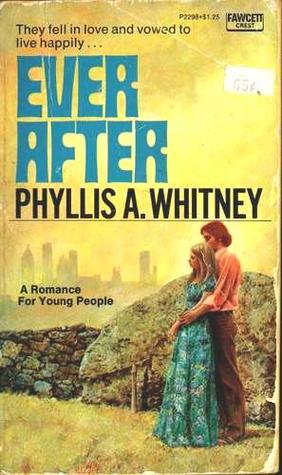
Ever After (1948)


Ever After
Phyllis Whitney, il. Elinor Darby (cover)
1948, Houghton Mifflin Company

The blue eyes that took in everything and gave out nothing examined Marel critically, coveted her hat and came wearily to rest when they reached her portfolio.
"Oh," she said. "One of those. Just out of art school, I suppose?"

Margaret Elizabeth "Marel" Pope comes to New York City from Chicago determined to make her way as an illstrator of children's books. When her initial interview at Embree Studios ends in the gentle observation that her drawings lack life, Marel goes off freshly determined to improve her work and win a place there. She luckily has a wealthy aunt, Peggy, whose fame as a hatmaker has resulted in a penthouse apartment she's opened to her struggling niece.

Marel won't stay long with Peggy. She quickly befriends a young writer, Chris Mallory, and they fall in love. But with postwar housing at a premium, the young couple can only find a tiny studio, which blows the problems of their early months of marriage all out of proportion. Does Marel believe that a woman can't have a career and a husband, as so many of her friends claim?

Whitney had a talent for summing people up. Marel's cynical coworker Gail:
...a tall, rather brassy-looking girl came to the door of the waiting room. No hair could ever have grown that color, but it was beautiful, sleekly combed and certainly eye-taking. She'd have been quite pretty except for the hard lines about her mouth and the suspicious way her blue eyes regarded the world.

The romance is quite nice, and Chris is a model young husband, willingly sharing the chores in a very modern way. Everything, in fact, is very 21st century until Marel realizes, as have so many heroines in so many romances, that their problems are all her fault.
About the author
1903-2008
Phyllis Ayame Whitney worked in libraries and bookstores in Chicago before marrying George A. Garner in 1925. They had a daughter, Georgia, in 1934. She worked for the Chicago Sun and the Philadelphia Inquirer during the 1940s. Her first book, A Place For Ann, was published in 1941. In 1950 she re-married; according to her NYT obituary, she divorced Garner in 1945 partly because he was not supportive of her writing. Two of her mysteries for children won the Edgar Allen Poe Award, and she was awarded the Grand Master Award from the Mystery Writers of America in 1988.
Books
Books for teens
Nobody Likes Trina (friendship)
The Fire And The Gold (early San Francisco)
A Long Time Coming (migrant workers)
Step To The Music (Civil War)
Linda's Homecoming
Willow Hill (race)
A Place For Ann

Career-type
Creole Holiday (acting)
The Highest Dream (working at the UN)
Love Me, Love Me Not
The Silver Inkwell (writer)
A Window For Julie (window dresser)
A Star For Ginny (illustrator)

Links

Other editions


Monday, March 29, 2010

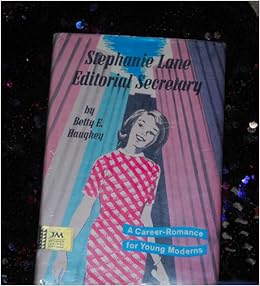
Stephanie Lane: Editorial Secretary (1967)


-->


Betty E. Haughey, il. Ray Abel (cover)
1967, Julian Messner

Stephanie took a Fifth Avenue bus for the fifteen blocks to the apartment, feeling very much a part bustling, home-bound New Yorkers. It was a good feeling.

Recent college grad and small-town Pennsylvania girl Stephanie Lane is happy to have achieved her short-term goal of moving to New York City and getting her foot in the door at a magazine. True, she's sharing a tiny place with a friend and the job is secretarial rather than editorial, and at a trade magazine (Elementary, a magazine for teachers) rather than a glossy, but it's a real success for a girl who knows nobody. She quickly learns that her job is going to be complicated by office politics. The magazine's editor, Elizabeth Rafferty, was recently hired over the head of associate editor Ann Michaels, and everyone is split between loyalties to either Miss Rafferty or Ann. Stephanie, forced to take sides, is drawn to Rafferty as Ann's cohorts make her uneasy.

Outside work, Stephanie begins dating native New Yorker David Powers. Her social life initially provides the fun side of reading old books. The fashions and the places seen through the prism of 43 years can be mind-bogglingly alien:
Later that afternoon, Jennie appeared beside Stephanie's desk, a pert red velvet pillbox perched atop her blonde curls.

or mind-bogglingly familiar:
Down below the parapet on which she was standing stretched the Wollman Memorial Skating Rink in Central Park, crowded with laughing, sweatered skaters. Beyond the rink she could see the tall hotels and apartment buildings of Central Park West bordering the park.

The plot moves along briskly and, right on cue, troubles pile up. Miss Rafferty goes away on business and the office relaxes so much that they're in danger of missing a deadline. A mysterious sharp decline in ad sales matches the mysterious sharp increase at their competitor, hinting at a sabateour at Elementary. Her father has a heart attack. Sweet and attractive David becomes a jerk.

Now for the darker side of old books. David, a seemingly perfect guy, produces a massive hatred of working women from out of nowhere, along with a 'quit or I walk' marriage proposal that Stephanie, stunned, turns down. Her sleepwalking misery over David's defection helps distract her from her career troubles until it's almost too late. 

The characters are well drawn and convincing, there is a nice amount of description and atmosphere, along with the career work and romance, and it's nicely resolved. And the situation with Stephanie's family alone is commendable, neatly switching the traditional situation around in what may be a little convenient but is a very nice trick to free our heroine from a very old girltrap.

So many career romances involve nursing or teaching or other careers I'm unfamiliar with, so it's nice to see something I know and fun to see how much publishing has - and hasn't - changed. Trade magazines, the frustrated longing to be working on glossies, cramming ads in at the last minute because of heedless salesmen, offices where men are the minority - all the same. A paper office, typewriters and foundry proofs (ie, final proofs made from set type) - gone. Extinct. Vanished. It's astonishing how completely technology goes away. Jennie's little red pillbox could always return as a zany retro look, but foundry production is never coming back.

I was an English major, got a foot in the door via an internship which is basically an updated version of an editorial secretary, and worked in trade publications (ie, not the prestigious ones). And this exchange still rings true:
"Why didn't I major in journalism or something else instead of English? It's totally useless unless you want to teach. And I don't."

Stephanie's wail of dismay echoes down the years. Her roommate's advice bears repeating, sometimes as a mantra;
"No, it's not useless," Joann had said. "There are dozens of fields here connected with literature: publishing, both books and magazines, bookstores and libraries."
Links
Wollman Memorial Skating Rink (now has an unfortunate name on it)

Other books
William Penn: American Pioneer
About the author
Betty Elen Haughey was from Pittsburgh. The only information I could find was that on the back of this book. Online, all I found was the Penn book and a research paper. She attended the University of Pittsburgh, graduated with a degree in fiction writing, worked in Pittsburgh and then moved to New York, where she followed a career path similar to Stephanie's. She returned to Pittsburgh eventually and worked for a research organization. Her final comments on the back cover flap was that she hoped to write more books for young people. It seems that she did not, and considering the generally high quality of this one, that seems a shame.


Saturday, June 13, 2009

Winter's Answer

Winter's Answer
Lucile McDonald and Zola H. Ross
1961, Thomas Nelson and Sons


"You're so poised, so sure of yourself," one of her sorority sisters had told her admiringly.

Would-be journalist Kit Langford is confident and ambitious, but her first taste of failure hits her badly when she transfers from a small college to a larger one and her writing and managerial talents aren't instantly recognized. Angry and humiliated, Kit takes comfort in winning a short internship at a New York magazine over the Christmas break, vowing to win a job there and never return to college. When that plan fails horribly, Kit runs again, joining her cousin Diane on a trip to Florida, where Diane is to rejoin her new husband, Jack.

But things don't go as planned in Florida either. Jack is in a coma after a car accident. Diane, frantic, spends every moment at his bedside while Kit hunts for a job to support them and the elderly boat Jack had bought as a re-sale project and temporary home. Kit is rejected over and over, first from the newspaper jobs she covets and then, lacking experience, even from menial labor positions. Desperate, she becomes the world's least apt waitress as a greasy spoon, on her feet from 7 AM to 1PM every day.

Kit grinned. She had left Northern expecting to conquer the world. Now she was afraid she could not even keep a menial job.

A depressed Kit bounces back quickly with attention from Paul, the handsome rich boy on the next boat over, and his low-key pal Red. She also finds satisfaction in refitting the Matilda, scrubbing, refurbishing and decorating the old boat in hopes of finding a buyer.

The book lacks a strong sense of place; Florida and New York both get the most cursory treatments, although New York fares slightly better. But the character of Kit is very strong and vivid. Her flaws are as compelling as her strengths, and she's a very appealingly resourceful protagonist, navigating her way around a strange place and reluctantly taking charge of the practical problems of Jack's illness. Her youthful encounter with reality is as painfully realistic today, in essence, though the details have changed (she limits her newspaper search to the women's page, after all). And in some ways, she's more realistic than a modern heroine would likely be - her worries about her clothes and their suitability would not occur to most modern YA heroines - yet is realistic. And yes, there is some clothing porn here:

The two-piece shantung ensemble was a gay print of blurred rose. It was perfect with Kit's dark hair and gray eyes. She could see herself marching confidently into a newspaper office. Wearing the jacket, she would look business-like; on removing it,she had a dine-and-dance dress

Paul's discomfort with working sounds odd, and the near-universal dismissal of Kit's efforts with the boat seem harsh. Red distinguishes himself (and feeds my old theory about boys named Red in fiction) by being the only one who mentions that it was pretty lucky for Diane that Kit came to Florida, and by admiring her work on the Matilda.

She thought back to the moment when she had dressed for her first day at Young Modern. Her confidence of two weeks ago was gone. It had been peeled from her by the failure of her New York dream, the shock of Jack's accident, Mr. Forbes' attitude, the rejection by the employment agency, the realization of her own shortcomings.

Kit loses her boundless confidence and discovers how hard it is to even just earn a living, let alone succeed. It's implied that this will make her a better person and more successful, that a knowledge of her own flaws will strengthen her for the career ahead. I have my doubts. True, Paul's example is convincing - a well-off boy who's never had to struggle and doesn't accept that he ever should have to work hard - but there's such a thing as having the confidence dented, not knocked back a few steps. Kit's so arrogant at the start that she can stand some knocks; others might have folded tents and been destroyed by what only serves to strengthen her. While the moral to this story might be similar to a fairy tale - be humble and work hard - I take from it that it's all luck. The right temperament in the right place at the right time...

About the Authors
Helen Girdey Ross aka Zola H. Ross
1912-
Associate Professor of Creative Writing at the University of Washington 1948-1955
Teacher in Kirkland, Washington
Pseudonyms included Z.H. Ross, Helen Arre, and Bert Lles

Lucile Saunders McDonald
1898-1992
Graduated from the University of Oregon in 1923
Freelance journalist who worked for the Seattle Times Magazine
Lived in Washington State most of her life, and was very interested in its history
Wrote or co-wrote nearly 30 books

Zola Ross and Lucile McDonald wrote several juvenile novels, including
The Mystery of Catesby Island (1950)
Stormy year (1952)
Friday's Child (1954)
Mystery of the Long House (1956)
Pigtail Pioneer (1956)
Wing Harbor (1957)
The Courting of Ann Maria (1958)
Assignment in Ankar (1959)
The Sunken Forest (1968)
For Glory and the King (1969)

Links
Obituary for Lucile Saunders McDonald
University of Washing Special Collections - Lucile Saunders McDonald

Monday, March 30, 2009

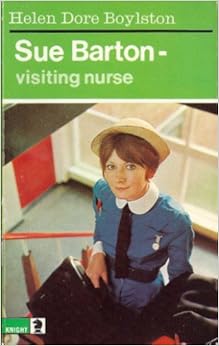
Sue Barton, Visiting Nurse


Helen Dore Boylston, il. Major Felten (jacket)
1938, Little, Brown

Not many of the houses looked prosperous and most of them were grimy; yet the street had charm, for traces of another era lingered in the crookedness of windows and doors, in the casual little yards, in old-fashioned wooden porches elaborate with scrollwork. New York roared around the street and above it. An icy wind from the harbor swept through it, blowing paper into the faces of pedestrians and tearing at the "For Rent" sign swinging over the door of the smallest house on the street - a tiny red brick house with green shutters and a white door.

Sue Barton and her friend Kit Craig have graduated from school and come to New York City (all 3 boroughs) to work for the Henry Street Visiting Nurse Service, a branch founded by Lillian Wald to improve slum conditions. In distinctive blue uniforms and toting large medical bags, they learn on the job about the challenges facing poor immigrants in neighborhoods all over New York. Their good friend Constance Halliday is not there because she's going to get married, but Sue has postponed her marriage to Dr. William Barry to work for a few years. Sue loves her work with Henry Street, and the excitement and novelty of New York, but as the year wears on and Bill gets impatient for their wedding, she feels torn between the job she loves and the man who loves her.

For a heroine in 1938, Sue's pretty gutsy about her own career ambitions. She does, finally, find a compromise to giving up her work and giving up her boy, but she gives him some pretty tough arguments first. The slums and streets of the city are given the same sort of colorful/crowded/exciting treatment that they usually get, and remind you irresistably of a Cagney movie. Descriptions of the poor immigrants and blacks Sue works with feel dated, particularly some dialogue, but the author clearly wants to communicate the both the wide range of peoples in New York and their essential decency, which are both very modern and pleasing attributes. Sue helps a depressed young Polish girl, an Irish child, a Polish woman, and assorted people of no distinct ethnicity, as well as several African-Americans (not so called in the book, of course); more importantly, she is helped by a bustling Italian woman, an Irish cop, a rabbi, and others. One oddity is the utter lack of any Catholic priests, considering the many Poles, Irish and Italians.

The style is plain and not particularly evocative or involving. The character of Sue is strong and vibrant, and the engine for the whole book. Her delight in the streets of New York, the people she meets, etc., lend the rather prosaic descriptions their power. The imagination fills in quite a lot from other books and from movies. There is a mystery, a romance, and a wedding, but the main story is the hard work of the nurses in a big city teeming with poor and working people.

Other Books

Sue Barton
Sue Barton: Student Nurse
Sue Barton: Senior Nurse
Sue Barton: Visiting Nurse
Sue Barton: Rural Nurse
Sue Barton: Superintendent Of Nurses
Sue Barton: Neighborhood Nurse
Sue Barton: Staff Nurse

Carol Page
Carol Goes Backstage
Carol Plays Summer Stock
Carol On Tour

Other information
The Tiny Pineapples website contains a frighteningly complete list of nursing-themed books.

Other Editions