Sunday, November 24, 2013

Trish (1951)


Trish
Margaret Maze Craig,
1951, Thomas Y. Crowell

“I wonder,” Pat said suddenly, and the tone of her voice was an odd combination of resentment and wistfulness, “how it would feel to be Connie Hyde.”

High school seniors Patricia Ingram and her best friend Mary Jo Tucker are not popular.  They’re not unpopular – Pat has a lovelorn male neighbor she doesn’t want, and neither girl is an outcast - but they want more.  At least, Pat does.  She’s spent her high school career existing on the fringe of the effortless cool clique run by sleek, poised girls like the famous Connie, and she wants that world.  Mary Jo, slightly wiser, suggests there might be aspects to that world Pat hasn’t considered, but Pat has a big reason to ignore this advice – she’s in love with a boy from that group.

Dick Keating – tall, rugged senior. Stubby, biscuit-brown hair and short, thick eyelashes of the same incredible color. Hazel eyes. Lips a trifle full perhaps, but lips that turned up engagingly at the corners when he smiled.  Very white teeth, just a little crooked.  A casual way of wearing clothes, an easy nonchalance of manner.  Dick Keating – the central figure in all her daydreams, and Connie Hyde’s exclusive property!

A chance meeting draws Dick’s attention to the slightly innocent Pat, and the novelty of a girl who isn’t smooth and jaded keeps his interest.  Astonished, Pat is thrilled to begin dating him.  From the start, though, she’s never sure where she stands with Dick, or how he’s going to fall between his interest in her unsophisticated charms and the allure of the familiar Connie.  Later, she begins to see that his interest in her has awakened something else in him, a possibility that he might not just love her but that he might be able to change into the person she thought he was – a boy with values like her own, rather than a boy from a social group that to Pat seems racy and vulgar. 

And then the book whips around, introduces a college boy with a bad reputation who falls instantly in love with Pat and destroys her relationship with Dick by creating (unwittingly) a situation where it seems they’ve had sex.

The last quarter of the book is jarring, and while the resolution between Pat and her flawed prince was believable, the way the book arrives at that resolution is baffling.  Introducing a major character that late, making their relationship that powerful, and writing out Pat’s friends so quickly were all odd choices. Otherwise, a nicely written teen romance.


About the Author
Margaret Maze Craig (1911-1964)
Craig was born and lived in Pennsylvania.  She was married and had 2 children, and worked as a home economics teacher. 

Etc.
The dedication reads "For my mother, La Belle Sutton Maze."

Other Books by Author
Julie (1952)
Marsha (1955)
Three Who Met (1958)
Now That I'm Sixteen (1959)
It Could Happen To Anyone (1961)

Other Editions


Monday, October 7, 2013

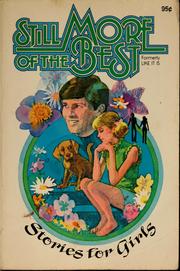
Still More Of The Best Stories For Girls (1972)


Still More Of The Best Stories For Girls (aka Like It Is)
Ed. N. Gretchen Greiner, il. Jim Conahan; il. Tom Nachreiner (cover)
1972, Golden Press

A fairly low-quality anthology of stories which are clearly intended to be very relevant. 


Stories:
Good-Bye, Miss Kitty by Jane L. Sears
High-school freshman Karen sets out to rehome her beloved cat when her parents’ impending divorce means moving to an apartment that doesn’t allow pets.  By far the best-written and most poignant of the stories in this anthology, this one still has the same odd, unreal quality of most of the others.

Dog-Sitter by Carl Henry Rathjen
Tena nervously faces down her first pet-sitting appointment as she chews on the bitter argument she’d had with her boyfriend’s father about girls applying to vet school.  The outdated – and somewhat dangerous – advice on dog handling is almost enough to distract from the typical denouement in which the heroine realizes – surprise! – that her crisis is all in her own silly little head.

Fly Free by Carol S. Adler
Clare has retreated into herself after an accident amputated two fingers.  Sent on an extended visit to a friend’s family, she’s drawn into the tense dynamic between the engineer father and his level-headed son who has no aptitude for math.  Well-written and involving.

A Person, After All by Constance Kwolek
Anne reads the obituary of a dull, frumpy teacher , and realizes that the woman’s  life contained parallels to her own.

Two Nice Girls by Frances Gray Patton
Two college girls, one black and one white, have a self-consciously self-congratulatory friendship until one gossipy chat exposes more of each’s background than she’d have liked.

They Don't Make Glass Slippers Anymore by Lael J. Littke
A teenager uses her little brother to get the attention of a handsome boy at the local amusement park.

The Year of the Baby by Carol Madden Adorjan
Only child Lorna is furious and unsettled when her parents announce that her mother is pregnant.

The Summer of Charlie Crip by Suzanne Roberts
Six months after her brother’s death in Vietnam, Karry is listlessly hanging around at the family’s summer cottage.  A rescued baby bird and a cautious new boy bring her back to life.

Debbies Faces Herself by Pauline Smith

 No Boy.  I'm A Girl! by M.J. Amft


Authors

N. Gretchen Greiner
A Batch Of The Best (1979)
My Little Book of Cats

Jane L. Sears (1929-2012)
Wrote nurse romances; her mother Ruth McCarthy Sears wrote gothic romances.  

Carl Henry Rathjen (1909-1984)
A prolific writer who contributed to the Trixie Belden series but concentrated on science fiction.

Carol S. Adler (1932-)
Better known as C.S. Adler.  Has written many children's books.

Constance Kwolek (1933-2009)
Published one novel, Loner, and wrote articles and short stories.

Frances Gray Patton (1906-2000)
A short story writer best known for her novel Good Morning, Miss Dove.

Lael J. Littke
Author of over 40 books, including many young adult novels and books aimed at the Mormon market.
 
Carol Madden Adorjan
A teacher who wrote several books.
 
Suzanne Roberts
Difficult to determine

Pauline Smith

M.J. Amft
A short story writer.


Links
A cranky boy review of this book (with original cover) and Greiner’s followup A Batch Of The Best.

Note
This seems to have been one of a series of young adult anthologies.  The others were: 
The Best Stories For Girls
More Of The Best Stories For Girls
A Batch Of The Best

Wednesday, October 2, 2013

The Skating Rink (1969)


The Skating Rink
Mildred Lee, il. Ilse Koehn (cover)
1969, The Seabury Press

One thing stood out, raw and bitter, in his mind: he was his father’s son and doomed to failure, no matter what he undertook.

Tuck Faraday, 15, is a poor country kid in rural southern Georgia.  Alienated by a stammer that’s evoked constant ridicule from family and classmates since he was little, he’s ready to quit school the moment he turns 16.  Then he meets Pete Degley.

“Degley’s the name,” he said.  “Pete Degley.”  His handshake made Tuck feel older than his fifteen years and he liked the feeling.  Pete Degley told Tuck he was going to put a roller-skating rink here beside the highway, confiding in him so naturally that it wasn’t till afterwards, when he thought the whole thing over, that Tuck saw anything unusual about it.

The rink is going up close to Tuck’s bedraggled house, where his bitter father Myron is struggling to keep a chicken farm going and his exhausted stepmother, Ida, labors every winter over a foully smelly and recalcitrant oil stove.  Tuck, staring at this despairing failure every day, is drawn to Pete’s optimism and the sense that his dream, his skating rink, could actually succeed.

Pete has reasons of his own for talking to Tuck.  His young wife, Lily, is a wonderful skater and Pete, with a bum knee and a couple decades on him, wants a young male skater to pair her with, as an exhibition to draw crowds and to give skating lessons.  So he trains the two in secret.

Curiously, as Tuck gains skill and confidence, he also gains insight.  He finds compassion for his teasing little sister Karen, loutish brothers Clete and Tom, and even his parents. 

About the Author
1908-2003
Mildred Lee Scudder was born a Baptist minister’s daughter in Alabama and spent her childhood travelling around the rural south, a region that appears in most of her books.  She worked as a librarian at the University of Alabama, and married James Scudder in 1947.   It also appears that she had married Edward Schimpff in 1929, and had 2 children. 

Other Books
The Invisible Sun (1946)
The Rock and The Willow (1963)
Honor Sands (1966)
Fog (1972)
Sycamore Year (1974)
The People Therein (1980)
The Bride Of the Lamb

Links
UA list of Alabama authors

Other Editions:

Interesting, the metamorphasis from the first edition to the paperbacks.  Tuck seems to go from being a kid to being a big teen to being John Travolta.


Wednesday, December 5, 2012

Surfboard Summer (1965)


 Surfboard Summer
Jean L. Sears
1965, Western Publishing Company
edition shown: 1969 Golden Press, A Golden Griffon Romance, il. Luciana Roselli

Suddenly Cindy's throat thickened, for in Mr. Marshall's eyes she caught the same flash of pity she had seen so often in Diane's.  They knew what was wron.  They understood her dread of going home to face her parents - and to look at that empty chair.

It's been five months since 16-year-old Cindy's older brother died in a car crash, and her mother is just going through the motions.  Struggling with her own grief and trying to take care of her mother, Cindy has been looking forward to their annual summer at her grandmother's San Francisco home and is devastated when it's cancelled.  Lonely now that her best friend has gone away for the summer, she wanders down to the beach of her California town and discovers surfing.  And the local surf god, Bix, who swoops in to rescue her when - well, when he nearly runs her over.  She doesn't mind, considering their ah, romantic ride back to the beach.

Crouching low while balancing with his feet tensed on the board's slippery surface, he did an about-face.  Cindy took a deep breath, then hooked her legs around his muscular waist.  A minute later, he lifted her knees up so that she was astride his broad shoulders.

Bix is a poster boy for the California coast -

His blond hair gleamed in the sun, and there were little white squint lines around the tanned skin on his temples, as if he had looked at a lot of oceans and smiled at a lot of pretty girls.

- and Cindy makes an impression by snapping a photo of him that gets picked up by a local newspaper, boosting his already high image and ego.  Then she learns to surf well and, with her fearlessness, wins him completely.  Or as completely as you can win over a guy like Bix.

Other plot points involve Heather, a rich girl whose bout of polio has left her with a crippled leg, and the tension between Bix's quintessentially middle-class surfing club and the beach bums.

Bix's usually affable face hardened before he answered.  "Beach bums!"  He shook his head disgustedly.  "They do anything for show, and they give the rest of us a bad name with their peroxided hair and wild parties."

Cindy's a likeable heroine, kind enough that her first instinct is to protect her heartbroken mother but sensible enough to rebel when her mother's initial foray out of grieving selfishness is to question her daughter's new hobby.  The California surfing scene feels like something out of the world of Gidget, and it's oddly impossible to imagine those nice, healthy, clean-cut early 1960's kids as surfers looking darkly at wild beach bums.  Didn't the beach bums win that war?

About the Author
1929-2012
Born in Kansas, Sears had a mother (Ruth McCarthy Sears) who wrote gothic mysteries and young adult romances.  Sears was a freelance writer who also wrote nurse romances and for Catholic publications.


Other Editions
The original book, which is so less attractive I've swapped it out for the paperback above:


Other books
Ski Resort Nurse
Television Nurse
Las Vegas Nurse


Links
Obituary

Vintage Nurse Romance Novels - blog with reviews of Sears's nurse novels


Saturday, November 24, 2012


Mystery Of The Long House
Lucile McDonald and Zola H. Ross
1956, Thomas Nelson & Sons
Edition shown: Pyramid Willow Books, 1964

Archaeology!  Barbara’s dark eyes clouded and she tossed her short brown curls crossly.  Of all the dull affairs!  Who cared about embalming life, either past or present.  She wanted to live it – now!

18-year-old Barbara Stratton is used to dealing with new environments; her father’s job in international banking has had the family moving around constantly all her life.  But her latest setting, an island off the coast of Washington State, is a disappointment.  She’d planned a summer of sailing parties, riding trips with the Tack Room Club and dances at the Boat Club.  Instead, she’s dispatched to a remote archaeology dig run by her new brother-in-law, Paul.  The soul of feminine arts, she bakes some brownies as a welcome treat and trips down to the site to introduce herself – and falls into a trench.  Most of the men forgive her quickly, but harried Paul and two of his students remain distant.  They have more pressing concerns than a bored teenager; their dig is of an Indian long house, and part of it appears to be on private land whose owner refuses to let them dig.  With only a partial dig possible, their funding is in jeopardy.  Barbara, meanwhile, is making friends with the locals and poking around in the mystery of the unfriendly neighbor, Mrs. Covey.

As the summer passes, Barbara finds herself becoming more interested in archaeology, and in one particular young archaeologist.  But she disagrees with the group’s aloofness from the locals.  When one man says, bitterly:

“None of these people understand.  They’re stupid and stubborn.”

Barbara counters with: 

…. “He doesn’t understand,” she said slowly.  “And none of you try to make him understand.  Maybe if you did, you’d have better luck.”

Somewhat unusually, the heroine spends much of her time alone.  The love interest angle isn’t developed until late, and Barbara basically rubs Paul the wrong way so that the rest of the team feels awkward befriending her.   Her loneliness and boredom keep her worrying away at the mystery, and finally give her the answer.

Slow, atmospheric and somehow boring.  I liked the other McDonald/Ross collaboration I’ve read, Winter’s Answer, which was similarly slow and atmospheric, but had a liveliness to it that this book lacks.

 Lucile Saunders McDonald (1898-1992)

Born in Oregon, Lucile Saunders became a journalist and worked at various newspapers in the Pacific Northwest.  She married Harold D. McDonald in 1922 and had two children.  She collaborated with Ross on several young adult novels in the 1950s and 1960s.

Zola H. Ross, aka Helen Girdey Ross
1912-1989
Associate Professor of Creative Writing at the University of Washington 1948-1955
Teacher in Kirkland, Washington.  Pseudonyms included Z.H. Ross, Helen Arre, and Bert Lle
 
Books by both
The Mystery Of Castesby Island
Stormy Year
Friday’s Child
Pigtail Pioneer
Wing Harbor
The Courting Of Ana Maria
Assignment In Ankara
Winter’s Answer
The Stolen Letters
The Sunken Forest
For Glory And The King


 Links


Sunday, June 17, 2012

The Unchosen (1963)


The Unchosen
Nan Gilbert
1963, Harper & Row
Edition shown: 1965 Scholastic, il. Bob Cassell (cover)

We three were the have-nots, leagued against the haves.  The left-out pretending not to envy the soughtafters.  Three high-school seniors who had never had a single date, not one - can you imagine it?

Ellen Frazer, awkward and pudgy, looks dispassionately at herself and her two friends  - Debbie Fuller (chubby and desperately boy-crazy) and Kay Nicholson (self-consciously tall and painfully skinny) - and concludes privately that they are The Unchosen.  She also concludes that their families are no help.  Her hearty German-American mother solves every problem with food and needs reassurance that her daughter is happy; Debbie's lack of popularity is made worse by having a younger sister who is extremely popular; and Kay's ongoing war with her feminine, fussy mother has embittered her against human relationships - an animal lover, she finds happiness in fussing over her beloved Fox Terrier, Midge.

But Ellen has an advantage.  She has been a collector of pen pals for years, living vicariously through their initial letters about alien lives in faraway places, but finding only disappointment with the subsequent flat updates on daily life.  With Norris Adair, she finds romance.  Norris sends long, interesting letters that thrill her, and they flirt through the mail.  The long-distance romance also gives her more respect among her friends - at least she has a sort of boyfriend.  Maybe. 

Over the course of their final year in high school, all three girls find their own ways out of anonymity.  Ellen's a typical protagonist; she's ambitious and self-aware, and too proud for her own ambitions.  She's quick to see the practical work that goes into making Ann Allison the most popular girl in the class, but can't quite figure out how to pull it off - and is not entirely aware that she lacks the commitment to fame, has a crippling amount of pride. It takes Kay's ruthlessly practical streak to mobilize the group - she calculates the number of unattached boys, and the percentage they'll have to approach to be assured of a reasonable rate of success.  And Debbie, once introduced to the male side of the school, goes on a tear.

"Oh, good grief, it's as simple as two plus two," Kay said impatiently.  "It you want to end up with five boys and you're only netting ten percent, you'd have to start out with fifty - see?"
"Gee," murmured Debbie, the blissful thought of five boys erasing her doubts as to how Kay proposed to snare them.

I have an affection for the teen novels that focus on the more average teen problems.  One of the worst things about being a teenager is how you're starting to realize that prosaic, clichéd situations can be extraordinarily painful, which means you suffer without getting any respect.  Here you are, at the height of your energy and passion, and your emotions are all inflamed by wanting a date to a stinking prom, or arguing with your mother.  Where's the drama, where's the grand scale?

This book pulls it off.  The writing is solid, and the characters are strong.  From brooding Ellen to defensively indifferent Kay to frantic Debbie, all three girls are convincing as nice outsiders who have to find their own ways to social happiness.  The pace is steady, but the pen pal plot is jerky, vanishing for much of the book and then resurfacing to tie everything up.  There is little feeling of place - the book is set in Oregon, but it's a stock, generic American suburb.  But best part may be the admission that you have to work to drag yourself out of the popularity gutter.  This is is refreshing; it's a lot more common to find books where the heroine's either rescued by a Ken doll or (more typically) realizes the popular kids are dull and her life's work lies with the cool outcasts.      


Covers
1963, Harper & Row at Amazon
1973, Harpercollins Childrens Books


About the Author
Mildred P. Geiger Gilbertson
From Eugene, Oregon
Graduated from the University of Texas, Austin in 1933


Websites
Loganberry Books  *notice the comments from Gilbert's daughter and granddaughter on that site

Nonfiction
See Yourself In Print (for children) (1968)

Children
365 Bedtime Stories (1955)
A Dog For Joey (1967)
 
Young Adult
The Strange New World Across The Street
Champions Don’t Cry (1960)
Academy Summer (1961)
Then Came November
A Knight Came Running (1965)

Picture
Hanna Barbera's Yogi Bear Takes A Vacation
Hanna Barbera's Fred Flintstone: Bewildered Babysitter
Nan Hanna Barbera's Fred Flintstone's Bewildered Baby-Sitter with Pebbles
The Three Fuzzy Bears
Sir Gruff (dog) (1947)
Young Macdonald On The Farm (1949) il. Theresa Kalb

Anthologies
Story Parade - "The Burglar Trap"
Fields And Fences
On My Honor (editor Marjorie Meyn Vetter, 1951)
Told Under Spacious Skies
Told Under The Stars And Stripes
From Many Lands