Wednesday, December 5, 2012

Surfboard Summer (1965)


 Surfboard Summer
Jean L. Sears
1965, Western Publishing Company
edition shown: 1969 Golden Press, A Golden Griffon Romance, il. Luciana Roselli

Suddenly Cindy's throat thickened, for in Mr. Marshall's eyes she caught the same flash of pity she had seen so often in Diane's.  They knew what was wron.  They understood her dread of going home to face her parents - and to look at that empty chair.

It's been five months since 16-year-old Cindy's older brother died in a car crash, and her mother is just going through the motions.  Struggling with her own grief and trying to take care of her mother, Cindy has been looking forward to their annual summer at her grandmother's San Francisco home and is devastated when it's cancelled.  Lonely now that her best friend has gone away for the summer, she wanders down to the beach of her California town and discovers surfing.  And the local surf god, Bix, who swoops in to rescue her when - well, when he nearly runs her over.  She doesn't mind, considering their ah, romantic ride back to the beach.

Crouching low while balancing with his feet tensed on the board's slippery surface, he did an about-face.  Cindy took a deep breath, then hooked her legs around his muscular waist.  A minute later, he lifted her knees up so that she was astride his broad shoulders.

Bix is a poster boy for the California coast -

His blond hair gleamed in the sun, and there were little white squint lines around the tanned skin on his temples, as if he had looked at a lot of oceans and smiled at a lot of pretty girls.

- and Cindy makes an impression by snapping a photo of him that gets picked up by a local newspaper, boosting his already high image and ego.  Then she learns to surf well and, with her fearlessness, wins him completely.  Or as completely as you can win over a guy like Bix.

Other plot points involve Heather, a rich girl whose bout of polio has left her with a crippled leg, and the tension between Bix's quintessentially middle-class surfing club and the beach bums.

Bix's usually affable face hardened before he answered.  "Beach bums!"  He shook his head disgustedly.  "They do anything for show, and they give the rest of us a bad name with their peroxided hair and wild parties."

Cindy's a likeable heroine, kind enough that her first instinct is to protect her heartbroken mother but sensible enough to rebel when her mother's initial foray out of grieving selfishness is to question her daughter's new hobby.  The California surfing scene feels like something out of the world of Gidget, and it's oddly impossible to imagine those nice, healthy, clean-cut early 1960's kids as surfers looking darkly at wild beach bums.  Didn't the beach bums win that war?

About the Author
1929-2012
Born in Kansas, Sears had a mother (Ruth McCarthy Sears) who wrote gothic mysteries and young adult romances.  Sears was a freelance writer who also wrote nurse romances and for Catholic publications.


Other Editions
The original book, which is so less attractive I've swapped it out for the paperback above:


Other books
Ski Resort Nurse
Television Nurse
Las Vegas Nurse


Links
Obituary

Vintage Nurse Romance Novels - blog with reviews of Sears's nurse novels


Saturday, November 24, 2012


Mystery Of The Long House
Lucile McDonald and Zola H. Ross
1956, Thomas Nelson & Sons
Edition shown: Pyramid Willow Books, 1964

Archaeology!  Barbara’s dark eyes clouded and she tossed her short brown curls crossly.  Of all the dull affairs!  Who cared about embalming life, either past or present.  She wanted to live it – now!

18-year-old Barbara Stratton is used to dealing with new environments; her father’s job in international banking has had the family moving around constantly all her life.  But her latest setting, an island off the coast of Washington State, is a disappointment.  She’d planned a summer of sailing parties, riding trips with the Tack Room Club and dances at the Boat Club.  Instead, she’s dispatched to a remote archaeology dig run by her new brother-in-law, Paul.  The soul of feminine arts, she bakes some brownies as a welcome treat and trips down to the site to introduce herself – and falls into a trench.  Most of the men forgive her quickly, but harried Paul and two of his students remain distant.  They have more pressing concerns than a bored teenager; their dig is of an Indian long house, and part of it appears to be on private land whose owner refuses to let them dig.  With only a partial dig possible, their funding is in jeopardy.  Barbara, meanwhile, is making friends with the locals and poking around in the mystery of the unfriendly neighbor, Mrs. Covey.

As the summer passes, Barbara finds herself becoming more interested in archaeology, and in one particular young archaeologist.  But she disagrees with the group’s aloofness from the locals.  When one man says, bitterly:

“None of these people understand.  They’re stupid and stubborn.”

Barbara counters with: 

…. “He doesn’t understand,” she said slowly.  “And none of you try to make him understand.  Maybe if you did, you’d have better luck.”

Somewhat unusually, the heroine spends much of her time alone.  The love interest angle isn’t developed until late, and Barbara basically rubs Paul the wrong way so that the rest of the team feels awkward befriending her.   Her loneliness and boredom keep her worrying away at the mystery, and finally give her the answer.

Slow, atmospheric and somehow boring.  I liked the other McDonald/Ross collaboration I’ve read, Winter’s Answer, which was similarly slow and atmospheric, but had a liveliness to it that this book lacks.

 Lucile Saunders McDonald (1898-1992)

Born in Oregon, Lucile Saunders became a journalist and worked at various newspapers in the Pacific Northwest.  She married Harold D. McDonald in 1922 and had two children.  She collaborated with Ross on several young adult novels in the 1950s and 1960s.

Zola H. Ross, aka Helen Girdey Ross
1912-1989
Associate Professor of Creative Writing at the University of Washington 1948-1955
Teacher in Kirkland, Washington.  Pseudonyms included Z.H. Ross, Helen Arre, and Bert Lle
 
Books by both
The Mystery Of Castesby Island
Stormy Year
Friday’s Child
Pigtail Pioneer
Wing Harbor
The Courting Of Ana Maria
Assignment In Ankara
Winter’s Answer
The Stolen Letters
The Sunken Forest
For Glory And The King


 Links


Sunday, June 17, 2012

The Unchosen (1963)


The Unchosen
Nan Gilbert
1963, Harper & Row
Edition shown: 1965 Scholastic, il. Bob Cassell (cover)

We three were the have-nots, leagued against the haves.  The left-out pretending not to envy the soughtafters.  Three high-school seniors who had never had a single date, not one - can you imagine it?

Ellen Frazer, awkward and pudgy, looks dispassionately at herself and her two friends  - Debbie Fuller (chubby and desperately boy-crazy) and Kay Nicholson (self-consciously tall and painfully skinny) - and concludes privately that they are The Unchosen.  She also concludes that their families are no help.  Her hearty German-American mother solves every problem with food and needs reassurance that her daughter is happy; Debbie's lack of popularity is made worse by having a younger sister who is extremely popular; and Kay's ongoing war with her feminine, fussy mother has embittered her against human relationships - an animal lover, she finds happiness in fussing over her beloved Fox Terrier, Midge.

But Ellen has an advantage.  She has been a collector of pen pals for years, living vicariously through their initial letters about alien lives in faraway places, but finding only disappointment with the subsequent flat updates on daily life.  With Norris Adair, she finds romance.  Norris sends long, interesting letters that thrill her, and they flirt through the mail.  The long-distance romance also gives her more respect among her friends - at least she has a sort of boyfriend.  Maybe. 

Over the course of their final year in high school, all three girls find their own ways out of anonymity.  Ellen's a typical protagonist; she's ambitious and self-aware, and too proud for her own ambitions.  She's quick to see the practical work that goes into making Ann Allison the most popular girl in the class, but can't quite figure out how to pull it off - and is not entirely aware that she lacks the commitment to fame, has a crippling amount of pride. It takes Kay's ruthlessly practical streak to mobilize the group - she calculates the number of unattached boys, and the percentage they'll have to approach to be assured of a reasonable rate of success.  And Debbie, once introduced to the male side of the school, goes on a tear.

"Oh, good grief, it's as simple as two plus two," Kay said impatiently.  "It you want to end up with five boys and you're only netting ten percent, you'd have to start out with fifty - see?"
"Gee," murmured Debbie, the blissful thought of five boys erasing her doubts as to how Kay proposed to snare them.

I have an affection for the teen novels that focus on the more average teen problems.  One of the worst things about being a teenager is how you're starting to realize that prosaic, clichéd situations can be extraordinarily painful, which means you suffer without getting any respect.  Here you are, at the height of your energy and passion, and your emotions are all inflamed by wanting a date to a stinking prom, or arguing with your mother.  Where's the drama, where's the grand scale?

This book pulls it off.  The writing is solid, and the characters are strong.  From brooding Ellen to defensively indifferent Kay to frantic Debbie, all three girls are convincing as nice outsiders who have to find their own ways to social happiness.  The pace is steady, but the pen pal plot is jerky, vanishing for much of the book and then resurfacing to tie everything up.  There is little feeling of place - the book is set in Oregon, but it's a stock, generic American suburb.  But best part may be the admission that you have to work to drag yourself out of the popularity gutter.  This is is refreshing; it's a lot more common to find books where the heroine's either rescued by a Ken doll or (more typically) realizes the popular kids are dull and her life's work lies with the cool outcasts.      


Covers
1963, Harper & Row at Amazon
1973, Harpercollins Childrens Books


About the Author
Mildred P. Geiger Gilbertson
From Eugene, Oregon
Graduated from the University of Texas, Austin in 1933


Websites
Loganberry Books  *notice the comments from Gilbert's daughter and granddaughter on that site

Nonfiction
See Yourself In Print (for children) (1968)

Children
365 Bedtime Stories (1955)
A Dog For Joey (1967)
 
Young Adult
The Strange New World Across The Street
Champions Don’t Cry (1960)
Academy Summer (1961)
Then Came November
A Knight Came Running (1965)

Picture
Hanna Barbera's Yogi Bear Takes A Vacation
Hanna Barbera's Fred Flintstone: Bewildered Babysitter
Nan Hanna Barbera's Fred Flintstone's Bewildered Baby-Sitter with Pebbles
The Three Fuzzy Bears
Sir Gruff (dog) (1947)
Young Macdonald On The Farm (1949) il. Theresa Kalb

Anthologies
Story Parade - "The Burglar Trap"
Fields And Fences
On My Honor (editor Marjorie Meyn Vetter, 1951)
Told Under Spacious Skies
Told Under The Stars And Stripes
From Many Lands
 

Tuesday, September 28, 2010

That Archer Girl (1959)


Anne Emery, il. Charles Geer (cover)
1959, The Westminster Press

Anne Archer was a Girl Who Had Everything.

A slim blonde from the oldest family in town, Anne Archer is a senior at the exclusive Auburn Academy, a private day school in a wealthy Chicago suburb. The holiday season, and the approaching end of her high school career, plus the spectacular debut her mother's planning for the spring, are making Anne restless.

...the debut always brought with it the gnawing question of what she would do afterward.

Part of her solution to the anxious boredom is to crash the local public high school's dance with another girl's boyfriend. Her problems seem to recede when she falls hard for Ron, and he for her. But she's aware that he's fallen in love with only one side of her, and she's even slightly conscious that if he sees who she can be, it would be a disaster.

Anne has a reputation, and not just as the local golden girl. Although her family connections and personal looks ensure a certain level of acceptability, she also has an unsavory history of going too far with too many boys. Anne dismisses the latter; that's who she was last year. This year - and the New Year - will be different. But when her best friend, brainy Christie, finds a male soulmate, it drives Anne over the edge. Despite her love for Ron, Anne's driven to make brainy, distant Kent respond to her. To be rebuffed torments her, and as Kent retreats further from her advances, she becomes frantic to gain his interest.

Anne's nastiness is made clear early:

"I hate people that make me feel sorry for them," Anne said. "It makes me kick them around. They ought to know better."

There are hints of why Anne's so cold and controlling - childhood cruelty at school, her parents' distance - but while they're offered as a way to understand her, she's never excused by either the author or the other characters. Anne herself takes pains to conceal any weakness, attacking it in others and impatient with criticism.

On the other hand, Ron's a little overly obsessed with Anne as his personal property. Her behavior is wrong, but his anger at her flirting seem a little creepy coming from an unmarried high school boy regarding his girlfriend.

Links
Image Cascade

Other Books by Author


Dinny Gordon Series:

Dinny Gordon, Freshman
Dinny Gordon, Sophomore
Dinny Gordon, Junior
Dinny Gordon, Senior


Senior Year
Going Steady
Sorority Girl
High Note Low Note
Campus Melody


County Fair
Hickory Hill

Sweet Sixteen
First Love True Love
First Orchid for Pat
First Love Farewell
The Popular Crowd
The Losing Game

Scarlet Royal
Vagabond Summer
That Archer Girl
Married on Wednesday
A Dream to Touch
Tradition
Bright Horizons
Mountain Laurel
Jennie Lee, Patriot

American Friend: Herbert Hoover
Mystery of the Opal Ring
Danger in a Smiling Mask
Carey's Fortune
The Sky Is Falling
Free Not to Love
Stepfamily

A Spy in Old Philadelphia
A Spy in Old Detroit
A Spy in Old New Orleans
A Spy in Old West Point


Saturday, July 31, 2010

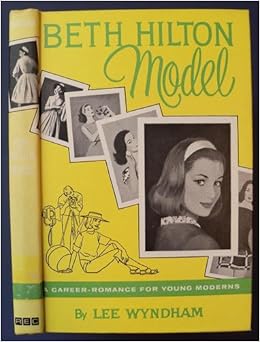
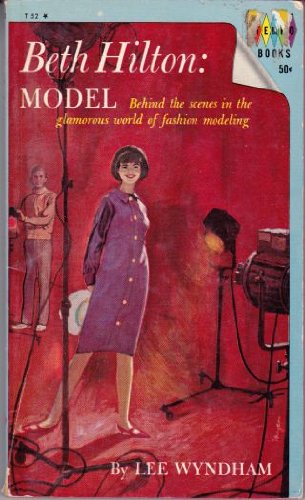
Beth Hilton: Model (1961)


Lee Wyndham
1961, Julian Messner

"Honestly, Beth, the way you stumble along, I expect you to fall over the flowers in the rug!" Mother said after an exasperating half-hour of walking and pivoting instruction in the living room.

New Jersey girl Beth is 17 when the painful comparisons to her cousin Lissa, a model since childhood, and an unfortunate experience in a school fashion show prompt her to enroll in charm school. Initially, all she wants is to learn some grace and poise, but a chance meeting with an arrogant young photographer spurs her to a long-derided ambition - modeling. She scrapes her way into the Queen's Agency and, upon graduation from high school, enters the world of modeling in New York City.

During the fifty-three minutes she had spent before Alex Turner's camera, she had eaten a bite out of seventeen generously spread peanut-butter sandwiches - and after the first nine or ten, it wasn't easy to "glow" over The Product.

Meanwhile, jaded child model Lissa is growing dissatisfied with her own lot, yearning toward Hollywood and jealous of her heretofore meek cousin's new confidence and ambition. Matters come to a head during an ice storm on a mountain, surprisingly enough. Matters between Beth and the treacherous photographer Amos resolve somewhat earlier; it will be no surprise that the two have chemistry.

Wyndham's books are always clear and well-written, and make the most of the careers highlighted. With such a glamorous career, though, she seems to have been overly cautious. There are nice bits about the realities of modeling, but not as much atmosphere as you might hope. There is one very funny scene when Beth, at a shoot to model a wedding gown, finds herself locked out of the church as a sympathetic crowd gathers around her, thinking she's been jilted.

Clothing porn, of course:

Her number was a swash-buckled black broadtail, supple as finest fabric and cut like a smart cloth coat, with a large notched collar and a saucy black beret to top it off.

But not as much as you'd expect. There is a sense of serious purpose about the career of modeling; history is given, techniques discussed, and it's made clear that Beth's half-hearted jump into the field has to become something more if she hopes to be a success.

Beth was impressed. John Robert Powers had founded the very first model agency. She had read about him and his famous "long-stemmed American Beauties" - Powers Girls who went on from modeling to earn fame and fortune in other fields as well: as actresses, motion-picture stars, fashion directors, designers, stylists, fashion-show producers.

At the end of the book is a short piece titled "If You Want To Be A Model." In italics is the advice "Don't let anyone "sell" you on the idea of doing anything which you suspect is not right or proper."


Other Editions
1964 Tempo paperback


-->
Author Bio
Jane Andrews Lee Hyndman aka Lee Wyndham was born in Russia in 1912. She came to the U.S. in 1923, and married in 1933. She worked in book publishing as an editor, for the Philadelphia Inquirer in the 1950s, and was a lecturer and columnist through the 1960s. This book draws on her own modeling experience. As a teacher at an NYU writing class, she taugh a young Judy Blume.
Links

Bibliography

Young Adult Fiction
Candy Stripers, New York, Messner, 1958
Bonnie
Lady Architect, New York, Messner, 1957
Buttons and Beaux, with Louise Gallagher, New York, Dodd, Mead, 1953
Golden Slippers, Vera Bock, illustrator, New York, Longmans, Green, 1953
Dance to My Measure, New York, Messner, 1958
Slipper Under Glass, Vera Bock, illustrator, New York, Longmans, Green, 1952
Camel Bird Ranch, Bob Riger, illustrator, New York, Dodd, Mead, 1955

Children's Fiction
A Dance for Susie, Jane Miller, illustrator, New York, Dodd, Mead, 1953
On Your Toes, Susie!
Susie and the Ballet Family, Jane Miller, illustrator, New York, Dodd, Mead, 1955
Susie at Dance Camp
Family at Seven Chimney House
Sizzling Pan Ranch, Robert D. Logan, illustrator New York, T.Y., Crowell, 1951

Nonfiction
First Book of Opera
Writing for Children and Teen-agers, New York, Writer's Digest, 1968
Florence Nightengale
Holidays In Scandinavia
Ballet For You
Thanksgiving, Hazel Hoecker, illustrator, New York, Garrard, 1963

Fairy Tales
The Mermaid and the Three Magic Rings
Russian Tales of Fabulous Beasts and marvels, retold by Lee Wyndham
Tales of Ancient Araby, New York, Watts, 1960
Tales from the Arabian Nights, Robert J. Lee, il, Racine, Whitman Publishing Co., 1965
Chinese Mother Goose Rhymes
The winter child; an old Russian folktale retold by Lee Wyndham


Monday, July 19, 2010

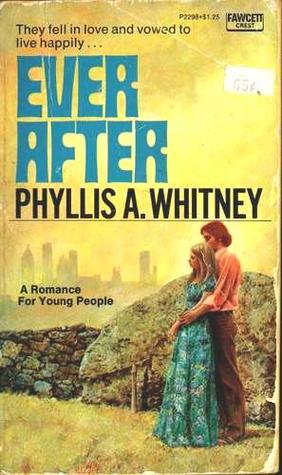
Ever After (1948)


Ever After
Phyllis Whitney, il. Elinor Darby (cover)
1948, Houghton Mifflin Company

The blue eyes that took in everything and gave out nothing examined Marel critically, coveted her hat and came wearily to rest when they reached her portfolio.
"Oh," she said. "One of those. Just out of art school, I suppose?"

Margaret Elizabeth "Marel" Pope comes to New York City from Chicago determined to make her way as an illstrator of children's books. When her initial interview at Embree Studios ends in the gentle observation that her drawings lack life, Marel goes off freshly determined to improve her work and win a place there. She luckily has a wealthy aunt, Peggy, whose fame as a hatmaker has resulted in a penthouse apartment she's opened to her struggling niece.

Marel won't stay long with Peggy. She quickly befriends a young writer, Chris Mallory, and they fall in love. But with postwar housing at a premium, the young couple can only find a tiny studio, which blows the problems of their early months of marriage all out of proportion. Does Marel believe that a woman can't have a career and a husband, as so many of her friends claim?

Whitney had a talent for summing people up. Marel's cynical coworker Gail:
...a tall, rather brassy-looking girl came to the door of the waiting room. No hair could ever have grown that color, but it was beautiful, sleekly combed and certainly eye-taking. She'd have been quite pretty except for the hard lines about her mouth and the suspicious way her blue eyes regarded the world.

The romance is quite nice, and Chris is a model young husband, willingly sharing the chores in a very modern way. Everything, in fact, is very 21st century until Marel realizes, as have so many heroines in so many romances, that their problems are all her fault.
About the author
1903-2008
Phyllis Ayame Whitney worked in libraries and bookstores in Chicago before marrying George A. Garner in 1925. They had a daughter, Georgia, in 1934. She worked for the Chicago Sun and the Philadelphia Inquirer during the 1940s. Her first book, A Place For Ann, was published in 1941. In 1950 she re-married; according to her NYT obituary, she divorced Garner in 1945 partly because he was not supportive of her writing. Two of her mysteries for children won the Edgar Allen Poe Award, and she was awarded the Grand Master Award from the Mystery Writers of America in 1988.
Books
Books for teens
Nobody Likes Trina (friendship)
The Fire And The Gold (early San Francisco)
A Long Time Coming (migrant workers)
Step To The Music (Civil War)
Linda's Homecoming
Willow Hill (race)
A Place For Ann

Career-type
Creole Holiday (acting)
The Highest Dream (working at the UN)
Love Me, Love Me Not
The Silver Inkwell (writer)
A Window For Julie (window dresser)
A Star For Ginny (illustrator)

Links

Other editions


Sunday, April 25, 2010

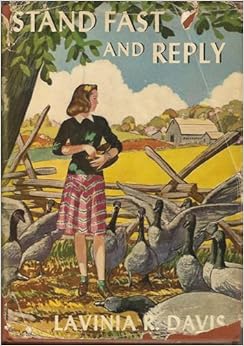
Stand Fast And Reply (1943)


Lavinia R. Davis,
1943, The Junior Literary Guild and Doubleday, Doran and Company

The summer visiting Aunt Helen up at Rye had been a flop. Aunt Helen hadn't known any of the younger crowd, and though Bitsy had tried to make friends she had stayed an outsider. She had comforted herself with the thought that at Sea Cliff she was one of the gang, but now, after two days, she wasn't at all sure. Bitsy felt cold and apprehensive as it occured to her that maybe she was the one who had changed. She had been something of a leader in the old rough-and-tumble, kid days, but maybe from now on she would always be on the outside.


When 17-year old Elizabeth "Bitsy" Close overhears the smoothest, most desirable boys in their upscale shore resort dismiss her as a kid, she's horrified at the idea that she might be socially doomed when she returns to her private Manhattan school in the fall. She's actually relieved when her parents break the news that a) bad investments have drained their finances and b) this, plus her father's orders overseas, means that her, her mother and her little brother Stanton will not return to their New York City apartment, but go live with relatives on a farm in Ohio. It may be strange and remote, but at least she won't endure the snubs and humiliation of being a social failure.

After a series of inevitable misunderstanding and awkward moments as the New York girl raised among catty socialites mingles with plain-spoken and taciturn farmers, Bitsy proves herself a hard worker. And her novelty makes her an instant hit at her new school. In short, the move does work out nicely for her social status. In the contrary way of things, however, that means less than it did in New York. With chores and farm work to do, the students scatter each afternoon, and Bitsy's no exception. Her closest friend is her cousin Tim, whose dedication to farming is in contrast to his older brother's; Bruce dreams of machinery and longs to be an airman, a desire inflamed by the nearby air base. Tim's a pure farmer; impressed by Bitsy's city style, he's more impressed by her willingness to help out on the farm.

"Wait until you meet my cousin Bitsy," he said proudly. "She's some looker and she works like a man."

Then her old life rears its head in the form of Byrd Gaylord (and here I pause in appreciation of such a name), the smoothest and most desirable of those older boys who'd dismissed her months earlier as a kid. Now, though, Byrd is in the Air Force and, lonely for his old world, latches onto her as a familiar face. Flattered and newly confident by her success in Ohio, Bitsy returns his interest. But is Byrd really what she wants from life?

A well-written story with an engaging heroine and atmospheric surroundings. Bitsy's a tad too adaptable; she tends to quickly grasp what she's doing wrong and correct it without trouble, and her social success is a bit overdone, if satisfying. Unusual book, in that she doesn't struggle much with the typical teen stuff, but cuts to the chase with the big issues - who to marry, what life to live, the survival of the farm, etc. Maybe because this is a war book, Bitsy's focused much more on adult issues than on teen ones.

A few things rankle or stand out. Bruce's casual dismissal of the Polish immigrant farm hand Steve as a dumb Pole, and the confusion whether he's mildly retarded or just a foreigner with limited English and emotional problems from WWI. The creepy trick Steve plays with a dead dog. The use of the word 'terrific' as a synonym for 'terrible.' The cool evaluation of a neighbor boy upon meeting Bitsy for the first time, as he sums her up as a nice piece. Tim's bluntness, which is meant to be natural but which seems to afflict him mostly around Bitsy; he's plenty smooth and courteous around a major from the nearby air base, for example. And finally, one character uses the phrase 'squaw winter,' apparently a regional term for the first freeze of winter, and which I've never heard before; Indian summer, yes, squaw winter, no.
About the author
(1901-1961) Lavinia Riker Davis also wrote as "Wendell Farmer."
Other books

Young Adult
Come Be My Love
Hearts In Trim
A Sea Between

Children's
Buttonwood Island
Plow Penny Mystery
Pony Jungle
Hobby Horse Hill
Melody, Mutton Bone and Sam
Sandy's Spurs
Janey's Fortune
The Secret of Donkey Island
Donkey Detective
We All Go Away
Americans Every One
Adventures In Steel (NF)
Island City: Adventures in old New York
It Happened On A Holiday (SS)
Round Robin
Spniney and Spike and the B-29

Easy
Roger and the Fox
Danny's Luck
The Wild Birthday Cake
Summer Is Fun

Adult
Evidence Unseen
Threat Of Dragons
Barren Heritage

Short Stories (children)
"Champion Fire ’n Feather" in the anthology Great Stories About Dogs

Links
Jane Cowl dahlias